
Rocket Money review: find the leaks
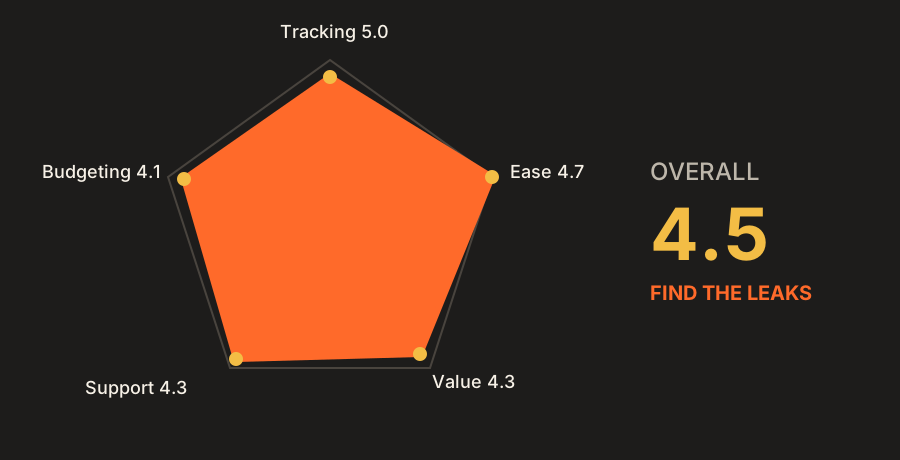
Verdict: Rocket Money earns 4.5/5 and is our strongest choice for spotting subscriptions and monitoring spending with little upkeep. The interface is calm, connected tracking works well, and the free tier is useful. EveryDollar still wins overall because Rocket Money’s budget offers less deliberate month-ahead control.
Put the recurring-charge view to work with our $47 subscription audit battle log, including the exact cancellation sequence.
What works
- Outstanding recurring-charge detection
- Useful free connected overview
- Clean automated spending summaries
- Optional cancellation assistance
What bites
- Less precise zero-based planning
- Premium pricing varies
- Negotiation can involve a success fee
- Some features encourage upgrades
Pricing requires one extra look
Rocket Money offers a free membership plus Premium with choose-your-price presentation. During our August 2026 check, the exact range depended on billing choice and the offer shown; common Premium prices sat around $7 to $14 per month, while annual billing could reduce the effective monthly cost. Because the enrollment screen is the controlling offer, verify the price and renewal cadence immediately before purchase.
The free tier connects accounts, identifies subscriptions and provides basic spending views. Premium adds expanded budgeting, net-worth tracking, credit-report features, unlimited categories, data export and cancellation assistance, although details can change. Bill negotiation is a separate service that can take a disclosed portion of first-year savings after success. It should be evaluated as a paid convenience, not free money.
Our weighted score
| Category | Weight | Score | Contribution | Field note |
|---|---|---|---|---|
| Budgeting & control | 30% | 4.2 | 1.260 | Easy limits, fewer planning decisions |
| Tracking & sync | 25% | 4.8 | 1.200 | Excellent recurring-charge visibility |
| Ease of use | 20% | 4.7 | 0.940 | Strong onboarding and summaries |
| Value | 15% | 4.5 | 0.675 | Good free layer; variable paid price |
| Support & privacy | 10% | 4.4 | 0.440 | Clear controls; complex service terms |
| Total | 100% | 4.515 | 4.5/5 rounded |
The subscription sweep is genuinely useful
Rocket Money found 17 recurring items across our connected checking and credit-card accounts. Four needed recategorization: a yearly software charge, a transit reload and two merchants with irregular timing. That left a single list more useful than the statements it summarized. It surfaced a $9.99 streaming renewal six days before billing and an annual $49 charge we had forgotten.
Detection is not cancellation. Premium assistance can handle supported merchants, but we cancelled our two test items directly to keep control of timing and confirmation. The important feature is the inventory: date, amount and change history in one place. A person who saves one forgotten $15 monthly subscription recovers more than a modest annual Premium price, though free users can act on much of the same visibility themselves.
Budgeting is easy, not exacting
The budget screen builds category limits from observed income and spending. It is friendlier than a blank spreadsheet and particularly good at showing whether current pace is likely to exceed a target. Categorization was accurate on 119 of 126 ordinary transactions before correction, or 94.4%. Merchant rules handled later repeats correctly.
What it does not create as forcefully is a complete plan for every expected dollar. We could monitor groceries, dining and transport quickly, but moving money between priorities felt secondary to the spending feed. That is a sound product decision for a monitoring app. It is also why EveryDollar scores 4.8/5: its core loop begins with intention, while Rocket Money begins with observation.
Who should use Rocket Money
Choose it if subscriptions have multiplied, you want connected accounts without building a detailed manual plan, or you respond better to automated alerts than category-by-category allocation. It also makes a strong first app for someone who needs to understand recent spending before adopting a stricter method.
Look elsewhere if you want envelope-style control, complex household collaboration or detailed investment planning. Our EveryDollar versus Rocket Money comparison separates the top two. The complete 2026 ranking includes YNAB and Monarch Money for those other jobs.
Frequently asked questions
How much does Rocket Money cost in 2026?
Rocket Money has a free tier. Premium uses a choose-your-price model; offers shown during our August 2026 check ranged by billing choice and account, commonly around $7 to $14 monthly, with lower effective monthly rates on annual billing. Confirm the exact renewal price displayed in your account before subscribing.
Can Rocket Money cancel subscriptions?
Premium members can ask Rocket Money’s cancellation service to help cancel supported subscriptions. Availability and success depend on the merchant, so it is assistance rather than a guarantee. The app is valuable even when you cancel manually because it gathers recurring charges into one visible list.
Is Rocket Money good for budgeting?
Yes, particularly for people who want automated spending limits and low-maintenance tracking. Its budgeting view is approachable, but it gives less hands-on control over a complete zero-based plan than EveryDollar or YNAB. We rate it as a stronger expense monitor than a planning system.
Is bill negotiation included?
Bill negotiation is a separate service, not simply unlimited work included in Premium. Rocket Money may charge a share of the savings when a negotiation succeeds, according to terms presented before authorization. Read the fee and savings-period details carefully before asking the service to negotiate.