
EveryDollar review: give every coin a post
Verdict: EveryDollar is our best budgeting app of 2026, scoring 4.8/5 after 35 days of daily use. Its focused zero-based workflow makes monthly decisions unusually clear. Premium is expensive for bank sync, but the capable manual version is free and the paid annual plan costs $79.99.
Want to make the method stick? Our EveryDollar wallet XP system turns planning, tracking and category repairs into a cooperative weekly score.
What works
- Fast, intelligible zero-based setup
- Free plan is genuinely usable
- Strong paycheck and fund planning
- Low visual clutter
What bites
- Bank sync requires Premium
- Monthly price is steep
- Limited investment analysis
- Best fit assumes active planning
Price and plans in 2026
EveryDollar’s official site listed a free plan and Premium at $79.99 a year or $17.99 a month when we checked on August 5, 2026. The annual price works out to about $6.67 monthly, making the month-to-month option more than twice as expensive across a year. A free trial was offered for Premium; renewal terms should be checked at signup.
Free includes manual transaction entry, customizable categories, planned-versus-spent views and savings funds. Premium adds bank connectivity, automatic transaction streaming, paycheck planning, financial roadmap features and expanded reports. The free tier is not a crippled demo: users willing to enter purchases can run the core budget indefinitely without paying.
Our weighted score
| Category | Weight | Score | Contribution | Field note |
|---|---|---|---|---|
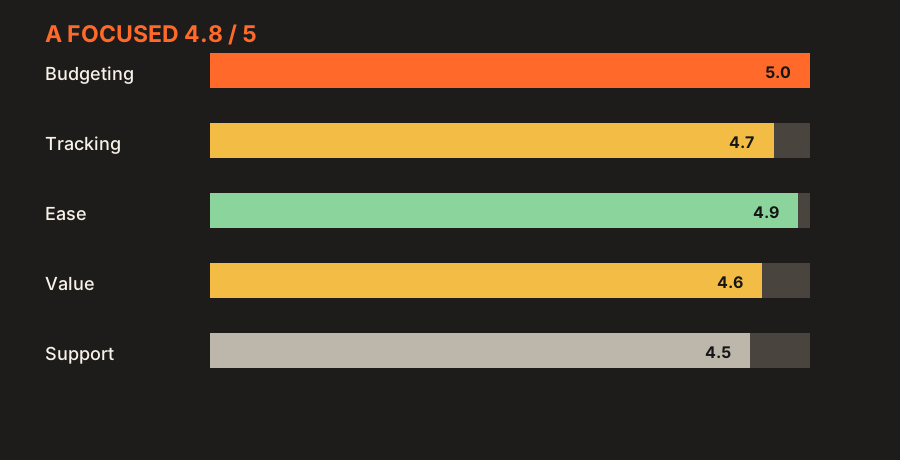
| Budgeting & control | 30% | 4.9 | 1.470 | Clear monthly jobs and fast reallocations |
| Tracking & sync | 25% | 4.6 | 1.150 | Reliable Premium import; no free sync |
| Ease of use | 20% | 4.9 | 0.980 | First workable budget in 11 minutes |
| Value | 15% | 4.7 | 0.705 | Strong free plan; annual Premium preferable |
| Support & privacy | 10% | 4.6 | 0.460 | Clear help; export controls could be broader |
| Total | 100% | 4.765 | 4.8/5 rounded |
What daily use feels like
The central screen asks one useful question: what should this month’s income do? We created 14 custom categories, three sinking funds and a $650 debt-payment target. The first balanced plan took 11 minutes. Moving $34 from restaurants to fuel required two changes and never made the plan feel “broken.” That sounds small, but quick correction is where many budget tools lose beginners.
Premium streamed 128 test-period transactions. Most checking and card activity appeared the same day; one card feed lagged overnight and then caught up without duplicates. Dragging or assigning imports to categories was simple. Category rules improved repetitive merchants, though split purchases still needed manual attention. The month-change workflow deserves praise: future obligations remained visible while July’s overspending did not vanish behind a decorative chart.
Who should choose it
EveryDollar fits people who want to make a plan before spending: first-time budgeters, debt-payoff households and anyone who likes zero-based budgeting but dislikes complicated software. Its strong free version also suits users who prefer manual entry. Recording each purchase creates friction, yet that friction can be useful when the goal is awareness rather than passive measurement.
Skip it if your priority is subscription cancellation, automatic net-worth tracking or investment analysis. Rocket Money is stronger for recurring-charge visibility; Monarch Money offers a broader household dashboard. People who want stricter handling of money already on hand may prefer YNAB’s method. Our full ranking maps those differences.
Why it beats Rocket Money—barely
EveryDollar wins because it is better at the primary job in the category: building and maintaining a forward-looking budget. Rocket Money is better at discovering forgotten subscriptions and summarizing what already happened. In our category-by-category comparison, the result is close. Choose based on whether you need a plan or a cleanup crew.
Frequently asked questions
Is EveryDollar free?
Yes. EveryDollar Free supports manual zero-based budgeting, custom categories, savings funds and transaction entry. Premium adds bank connectivity, streamed transactions, paycheck planning, reports and other conveniences. On August 5, 2026, the official price was $79.99 per year or $17.99 per month after the trial.
Does EveryDollar connect to bank accounts?
Only Premium includes bank connections and automatic transaction streaming. Connections were generally stable during our 35-day test, although one credit-card update lagged until the next morning. Free users enter transactions manually, which adds work but can make spending decisions more deliberate.
Is EveryDollar good for couples?
It can be, especially when both people agree on zero-based budgeting and review the plan together. Sharing one account keeps the category plan consistent, but EveryDollar is less sophisticated than Monarch Money for separate logins, household dashboards and a broader combined view of investments.
What is the biggest EveryDollar drawback?
Automatic bank transaction import is locked behind Premium, while several rivals offer some connected tracking for less or free. EveryDollar also prioritizes monthly cash-flow planning over investment and net-worth analysis. That focus is excellent for budgeting, but it is not a complete financial dashboard.