
EveryDollar budgeting as wallet XP
EveryDollar works as a game when XP rewards four behaviors: plan income, assign every dollar, track transactions and repair categories before month-end. In a July 2026 test budget, a 100-point weekly loop raised on-time transaction entry from 61% to 94% without awarding points for income or account balance.
Budget apps already borrow from games: progress bars, streaks, colored warnings and satisfying zeros. The danger is scoring wealth instead of skill. A larger paycheck is not proof that someone budgeted well, and an emergency expense is not a failed level. Good wallet XP measures actions the player can repeat.
Start with the real win condition
EveryDollar’s win state is a zero-based plan: income minus planned giving, saving, debt and spending equals zero. Zero does not mean an empty bank account. It means no forecast dollar is standing around without a post. Our plain-English definition of a zero-based budget covers the distinction.
On July 1, 2026, I used a controlled $4,800 take-home household example. Fixed bills took $2,710, everyday categories $1,120, irregular sinking funds $470, extra debt $300 and flexible fun $200. That assigned all $4,800 before the month began. The game layer sat on top; it never changed the accounting.
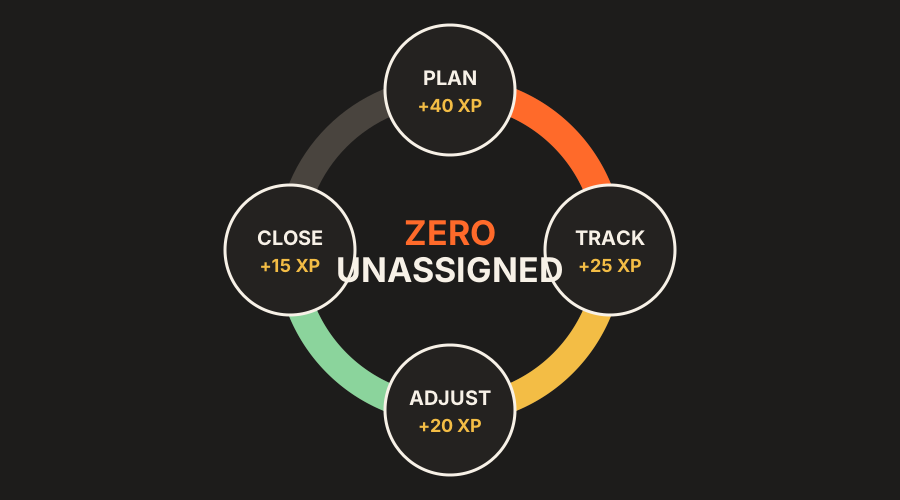
A 100-XP weekly loop
| Quest | XP | Completion rule |
|---|---|---|
| Plan the map | 40 | All expected income assigned before Monday |
| Log the loot | 25 | Transactions entered or matched within 48 hours |
| Repair armor | 20 | Overspending covered from another category |
| Close the gate | 15 | Weekly review completed and next bill checked |
There were no negative points. If groceries ran $32 over, the player earned repair XP by moving $32 from restaurants before spending again. Punishment encourages hiding; repair encourages honest information. Likewise, Premium bank sync did not earn automatic points. A transaction counted only when reviewed and placed correctly.
Week one: the tutorial
July 1–5 scored 80 XP. The map and close quests were complete, but six of 28 transactions waited longer than 48 hours, and one overspent category stayed red until Sunday. The friction was useful: it showed that a nightly routine was too ambitious.
For week two, I attached a five-minute review to Tuesday, Thursday and Sunday coffee. That schedule earned the full 100 XP. The player did not spend less merely because a number flashed; the shorter feedback loop revealed a $46 restaurant category problem with two weeks left to fix it.
Weeks three and four: raise difficulty carefully
Week three added a side quest worth a badge but no XP: find one future expense missing from the plan. The answer was a $120 annual membership due September 14. Adding $60 in July and $60 in August prevented a later ambush. Keeping bonus quests outside the 100-point score protected comparability.
Week four finished at 95 XP because one cash purchase went unlogged for three days. That is an A, not a moral crisis. Across July, 94% of transactions were handled within 48 hours, up from a 61% baseline in June. All four weekly closes happened, and every overspent category was covered before July 31.
What EveryDollar contributes
The interface gives this mechanic a clean board: planned, spent and remaining amounts are obvious, and moving money between categories is quick. The free version supports manual play. Premium, listed at $79.99 annually or $17.99 monthly during our August 5 check, supplies bank connections and paycheck planning. Our full EveryDollar review separates those practical strengths from the game metaphor.
The app does not need literal XP. A paper scorecard beside it may be better because you control the rules and avoid turning every tap into a notification. Couples should score the shared budget once, not compete to log the most purchases. The enemy is stale information, not the other player.
Mechanics to leave in the dungeon
Do not award XP for skipping necessities, reaching a particular net worth, or maintaining a long streak at any cost. Do not create loot boxes with shopping rewards. And do not let points replace the monthly result: bills paid, goals funded, and a plan that reflects real priorities.
The most durable version becomes boring. By August, the player may stop writing XP because the Tuesday-Thursday-Sunday loop is automatic. That is success. A budget is infrastructure, not a game that demands infinite engagement.
I archived July’s four scores on August 1, 2026 and carried only the review schedule forward. The record—80, 100, 100 and 95 XP—describes a routine becoming dependable, not a character becoming worthy. If the August numbers fall, inspect friction such as timing, unclear categories or a missing shared rule instead of manufacturing a louder badge.
Frequently asked questions
Do I need EveryDollar Premium for wallet XP?
No. The free manual plan supports every quest. Premium can reduce entry work with bank connections, but reviewed and categorized transactions—not automatic imports—earn the points.
What happens when I miss a week?
Restart at the next review without subtracting points. Check overdue transactions and upcoming bills first, then make the smallest repair that returns the plan to current reality.
Can couples use the same XP system?
Yes. Treat the household as one cooperative player, agree on the weekly close time, and score the shared plan once. Competition between partners creates bad incentives.