
EveryDollar vs Rocket Money
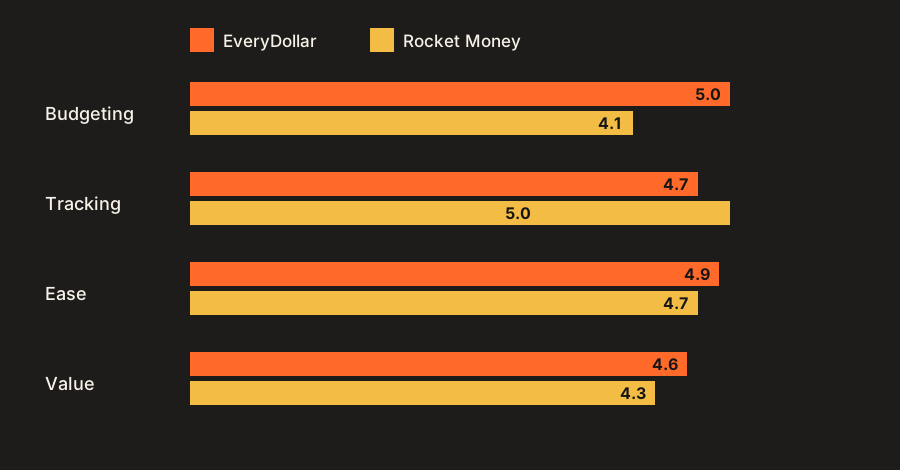
EveryDollar wins narrowly. Its 4.8/5 score beats Rocket Money’s 4.5/5 because it turns income into a clear, forward-looking plan. Rocket Money is the better automated expense tracker and subscription hunter. Choose EveryDollar to direct money; choose Rocket Money to expose where it already went.
| Category | EveryDollar | Rocket Money | Winner |
|---|---|---|---|
| Monthly planning | Full zero-based plan | Automated category limits | EveryDollar |
| Transaction tracking | Strong, but sync is Premium | Connected free overview | Rocket Money |
| Subscriptions | Ordinary categorization | Excellent detection and history | Rocket Money |
| Ease for a first budget | 11-minute guided setup | Fast, mostly automatic setup | Tie |
| Free-plan control | Complete manual budget | Useful monitoring, lighter plan | EveryDollar |
| Premium value | $79.99/year; $17.99/month | Flexible offer, often $7–$14/month | Tie |
| Couples | Strong shared planning ritual | Easy shared visibility | EveryDollar |
| Overall score | 4.8/5 | 4.5/5 | EveryDollar |
For a feature-level reality check beyond subscriptions, see our cashback and round-up loot table, ranked by net annual gain.
Budgeting: EveryDollar takes the crown
EveryDollar starts with expected income and refuses to call the job finished until every dollar has a purpose. That does not mean spending everything: saving and debt repayment are jobs too. During testing, we changed a grocery target after a high first week, moved $34 from dining to fuel, and increased a debt payment after payday. Each decision stayed visible inside one coherent plan.
Rocket Money’s approach is more observational. It inferred category limits from connected history and displayed spending pace clearly, which is useful when you do not want to construct a budget line by line. The difference is agency. EveryDollar repeatedly asks what should happen next; Rocket Money is exceptionally good at explaining what just happened. For a publication judging budgeting apps, planning receives the heavier weight.
Tracking and subscriptions: Rocket fires back
Rocket Money found 17 recurring items across our test accounts and placed upcoming charges on one useful screen. It caught a $9.99 streaming renewal six days early. Four items needed correction, but the remaining inventory would have taken far longer to assemble from statements. Premium cancellation assistance exists for supported merchants, though cancelling directly gives the user tighter confirmation and timing.
EveryDollar imported 128 transactions in its Premium test and handled normal merchant rules well. One credit-card feed lagged overnight. Its weakness is commercial, not technical: connected import requires Premium. Free users type transactions manually. That can create useful awareness, but a person specifically shopping for effortless monitoring should choose Rocket Money.
Price: compare the annual reality
As checked August 5, 2026, EveryDollar offered a permanent manual free tier. Premium cost $79.99 annually, equivalent to about $6.67 monthly, or $17.99 when paid month to month. Paying monthly for a year would cost $215.88, so the annual choice is plainly stronger for continuing subscribers.
Rocket Money also offered a useful free tier. Premium used flexible checkout pricing, with the precise range varying by billing selection and offer; common prices during our check were roughly $7 to $14 monthly, with lower effective rates possible on annual billing. Its bill-negotiation service can carry a separate share-of-savings fee. Read the displayed renewal and service terms instead of relying on a remembered headline price.
Free versions: two different bargains
EveryDollar Free is the better no-cost budget. Custom categories, savings funds, planned-versus-spent numbers and manual transactions are enough to run the method. Rocket Money Free is the better no-cost monitor. Connected visibility and recurring-charge detection create value with less labor, but the planning system has fewer levers.
A practical trial is simple. If you are happy to record purchases and want intentional limits, start with EveryDollar Free. If logging every transaction guarantees abandonment, connect Rocket Money and inspect four weeks of reality. Our selection guide explains how long to test before paying.
Couples and irregular income
A shared EveryDollar plan creates an explicit conversation: both partners see the same category jobs and must agree when money moves. Its paycheck planning in Premium is useful when income arrives on multiple dates. Rocket Money is calmer for partners who mainly need a combined view and alerts, not a weekly allocation meeting. Neither is our first choice for advanced separate logins; Monarch Money handles household dashboards better.
For irregular income, EveryDollar’s deliberate planning wins when users budget only money they can reasonably expect and revise after it arrives. Rocket Money’s history makes variable patterns easier to see, but averages can disguise a lean month. Base essential commitments on a conservative income floor, then assign extra money after a stronger payment clears.
Final decision
Pick EveryDollar if the problem is indecision: you need a clear plan, debt targets and active category tradeoffs. Pick Rocket Money if the problem is invisibility: forgotten subscriptions, scattered accounts and spending you notice too late. EveryDollar wins 4.8 to 4.5, but Rocket Money wins its narrower job convincingly.
Read the full EveryDollar review, the complete Rocket Money review, or see both in our seven-app ranking.
Frequently asked questions
Which is better, EveryDollar or Rocket Money?
EveryDollar is better overall for people who want an active monthly spending plan; it wins our comparison 4.8 to 4.5. Rocket Money is better for automatic expense monitoring and subscription discovery. The right choice depends on whether you need to direct future spending or audit past spending.
Which app has the better free version?
It depends on your tolerance for manual work. EveryDollar Free provides a complete manual zero-based budget but no bank sync. Rocket Money Free connects accounts and finds recurring charges, but its planning controls are lighter. We give Rocket Money the free-automation edge and EveryDollar the free-planning edge.
Can couples use both apps?
Yes. EveryDollar works best when a couple maintains one shared zero-based plan and holds regular budget check-ins. Rocket Money can give a low-maintenance overview of connected household spending. Neither offers the depth of dedicated household collaboration and separate member access found in Monarch Money.